Wednesday, 26 April 2017

26/04/17 - Facebook admits: governments exploited us to spread propaganda

https://www.theguardian.com/technology/2017/apr/27/facebook-report-government-propaganda


Facebook on Thursday detailed the well-funded and subtle techniques used by countries to spread misleading information to promote their goals.

The article focuses on the fact that recently Facebook has admitted to the possibilities of governments using their platform and other social media in order to spread propaganda. The social media giant admitted that they had been exploited and using algorithms to track similar patterns used in the US election, they found over 30,000 French accounts before the French presidential election.
  • Company will step up security to clamp down on ‘information operations’
  • Facebook suspended 30,000 accounts in France before presidential election
  • In a white paper authored by the company’s security team and published on Thursday, the company detailed well-funded and subtle techniques used by nations and other organizations to spread misleading information and falsehoods for geopolitical goals. 
  • In its effort to clamp down on information operations, Facebook suspended 30,000 accounts in France before the presidential election.
  • The company also explained how it monitored “several situations” that fit the pattern of information operations during the US presidential election.
  • At the same time, a separate set of malicious actors created fake Facebook accounts to falsely amplify narratives and themes related to topics exposed in the stolen data.

Personally, this is a huge story. It singlehandedly affirms everyones suspicions that the social media platforms which have little to no editorial control had been used by governments as a way to push specific agendas or propagandas, especially those of the right wing ideologies. This essentially goes to prove the reasons why there had been a sudden surge in right wing propaganda being used over the internet with more and more right wing politicians being elected.

26/04/17 - FaceApp apologises for 'racist' filter that lightens users' skintone

https://www.theguardian.com/technology/2017/apr/25/faceapp-apologises-for-racist-filter-which-lightens-users-skintone

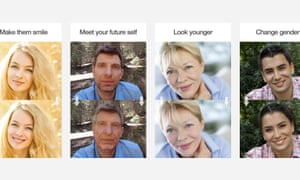
FaceApp, an app which uses neural networks to manipulate images, came under fire because one of its filters automatically lightened users’ skin.

The article talks about a recent app called FaceApp which uses filters and face recognition software/algorithms to alter an image or camera feed of a person. The app allows users to apply different filters such as the gender swap or the old filter. However, there is one filter called the "hot" filter that when applied made the user's skin appear lighter than that of their natural tone. This sparked some controversy as it implied that the creators believe people with lighter skins to be more attractive than those of darker skin.
  • The creator of an app which changes your selfies using artificial intelligence has apologised because its “hot” filter automatically lightened people’s skin.
  • Yaroslav Goncharov, the creator and CEO of FaceApp, apologised for the feature, which he said was a side-effect of the “neural network”.
  • This is by no means the first time an app which changes people’s faces have been criticised for racial insensitivity.

Personally, I think this is over-sensitization. It can easily be argued that such pre-defined filters would have different aspects of traits to them which could be misinterpreted, although it is perceived as racism, it is most likely just an honest mistake. I do not believe that the creator had any immoral intentions as he intended to make the app for entertainment purposes. I believe we live in a society where every small detail is seen as offensive and needs to be fixed, which could be a result of too much information.

Tuesday, 25 April 2017

Ignite presentation notes

Ladan

  • Focus on Twitter
  • US General election, politicians use Twitter
  • News agenda, audience discussion
  • Interconnected world
  • Social media movements #BlackLivesMatter
  • Citizen journalism, UGC
Abayomi
  • Napster 1999
  • Streaming, delivering music without download
  • Majority of Spotify users are 18-29 year olds
  • "Access rather than own"
  • Use of social media marketing appeals to milenial audiences
  • 50 million songs streamed in 2015
Amrit
  • Instagram bought by Facebook
  • 8% of 65+ mostly youth on Instagram
  • Cyberbullying is possible
  • Huge influence of user generated content
  • Mass audience is encouraged to partake in consumerism
  • Americanisation, consumerism
  • Objectification of men and women
Callum
  • New Activision, Vivendi 2007
  • Activision - Blizzard, 2008
  • User generated content not prominent
  • Game market is expected to grow
  • Black Ops 3 was advertised on Snapchat
  • Marwick (2008) technopanic
Katie
  • Traditional distribution has changed for documentaries
  • Binge watching culture
  • YouTube is damaging to the documentary genre
  • Social media is used consistently, identification
  • Docu-dramas appeal to a larger audience
  • Added depth to documentaries which makes it relatable and sensationalises the topic
Harkiran
  • Lionsgate was originally Cineplex
  • Hunger Games was produced and distributed by Lionsgate
  • Cinema audience is older generation
  • Move to online, on demand services
  • 2014 had a 5.1% decrease of cinema goers
  • On demand offers a modern distribution model
Khadijah
  • Audiences for Netflix are mostly mainstreamers
  • It wasn't launched in the UK until later
  • Very branded presence
  • Creating original content
  • Focusing on current issues and debates
  • Promotion through social media
John
  • Apple Music is available in more than 100 countries
  • Unsigned artists can sell their work to iTunes
  • Streaming has created a boost in the music industry after years of decline
  • On demand music rose to 76%
  • The global music industry has grown

Wednesday, 19 April 2017

19/04/17 - Gunman's video prompts Facebook rethink

http://www.bbc.co.uk/news/technology-39625679


Steve Stephens

The article focuses on the recent case of Steven Stephens. Stephens was a 37 year old black male that posted different videos and Live streams of him going on a killing spree. The first video which showed Stephen's intent to murder was uploaded but not reported to Facebook. The second video was of Stephens shooting whilst the third was a Live stream of him confessing to his crimes. The live stream lasted 5 minutes and was flagged for Facebook staff but the other videos were not. This has led to Facebook to launch a review of how it deals with the content on its website.
  • Facebook has launched a review of how it deals with violent content on its network.
  • The announcement came after a video showing a killing was posted to Facebook on Sunday and remained there for more than two hours.
  • “We know we need to do better,” a company executive said.
  • Facebook has faced considerable criticism due to the length of time the violent video spent published on the network.
  • "As a result of this terrible series of events, we are reviewing our reporting flows to be sure people can report videos and other material that violates our standards as easily and quickly as possible,” wrote Justin Osofsky, Facebook’s vice-president of global operations.
Personally, I think Facebook is under a lot of heavy fire recently. This is entirely due to the fact that the way they deal with certain aspects of the social media site is completely mismanaged or outdated. Therefore, I believe that although it is a huge company, Facebook will die out sooner or later. This is entirely due to the fact that the social media site has not been keeping up to date with the rapid changes of the world wide web.

19/04/17 - UK internet ad spend passes £10bn as Google faces YouTube row

https://www.theguardian.com/media/2017/apr/12/uk-internet-ad-google-youtube-mobile-video-tv

Google logo

The article focuses on how the amount of money spent on internet advertising in the UK last year alone had been more than £10billion. The article also focuses on the fact that major online companies are doubling the amount that they spend on mobile video adverts. This is due to the fact that the growth of mobile users on the internet and therefore a lot of companies are choosing to target the platform or device that is best suited for their audience or even demographic. 
  • Internet advertising spend surged above £10bn in the UK last year as companies more than doubled the amount they spent on mobile video ads.
  • The year-on-year increase of 17% on 2015 comes as many advertisers have pulled campaigns from Google and YouTube after it emerged that some ads have been running around inappropriate content such as extremist videos. 
  • However, the overall trend is for growth. Last year’s increase, the biggest since 2007, was fuelled by a boom in mobile ad spend, which rose by 51% to £3.9bn.
  • “People are increasingly using their smartphones to watch more clips, programmes and films,” said James Chandler, the chief marketing officer at the Internet Advertising Bureau UK
  • “Consequently, as companies have to follow what the industry calls ‘eyeballs’ to get their ads in front of people, they have to allocate more budget to mobile and online video as that’s where people are spending more time.”

Personally, I think it's interesting to see how companies are increasing their spending for internet advertising. It is especially obvious that these are where the users and target audiences are present and therefore it only makes sense that the companies go where the demand is. However, I believe that if spending is only going to be increased, over time the internet will be filled with adverts which are going to make people want to use Ad Blocking software.

Wednesday, 12 April 2017

12/04/17 - From nasty to nice: how adblockers are trying to pivot

https://www.theguardian.com/media/2017/apr/12/adblockers-trying-pivot-nasty-nice


Adblock Plus, one of the largest desktop adblockers, bought microdonation platform Flattr.

The article focuses on the fact that Adblock Plus has been highly controversial amongst users, developers and publishers. The fact of the matter is that it is incredibly difficult to monetize the internet, and in the early days, the use of adverts on the internet were highly crucial to the generation of ad revenue by publishers and companies. The AdBock Plus software was highly used by people around the world, however there were many cases where the company chose to whitelist certain corporations if they were able to pay certain amounts. AdBlock Plus has also been known in the past to create and develop different aspects of advertising for companies that are considered less annoying than standard adverts.
  • Adblocker developers argued that ad-supported media on the net was abusing its readers
  • Publishers argued that blocking ads was tantamount to theft
  • Britain’s IAB estimates 22% of visitors block ads, the same as this time last year
  • Some sites have started appealing to the morality of visitors, pointing out that blocking adverts deprives publishers of revenue, and requesting adblocking readers whitelist their domains.
Personally, I think it's great that AdBlock Plus are coming up with different ways to improve the relationship and working between users, developers and publishers. A lot of the time users want to remove these adverts that they find annoying, however at the same time a publisher's bills need to be paid and the only way they can do so is by cashing in on ad revenue from the content that they create. Although I think its great that a sort of middle ground is appearing, however I think that its important to not to lose sight of the greater picture which is the internet being a place of freedom.

12/04/17 - Revealed: the more time that children chat on social media, the less happy they feel

https://www.theguardian.com/society/2017/apr/09/social-networks--children-chat-feel-less-happy-facebook-instagram-whatsapp


Researchers have found that the more time children spend chatting online, the less happy they feel about their life overall.

The article focuses on how a study was done by economists at the University of Sheffield that talks about how young people that use social media are more likely to feel less happy in their everyday life. It also shows that almost 90% of young people use social media online and that there is a 14% probability that it will affect their happiness. The study also states that young people now spend more time online rather than watching television.
  •  A study has revealed that the children who spend more time on online social networks feel less happy in almost all aspects of their lives.
  • The research by a team of economists at the University of Sheffield, to be presented at this week’s Royal Economic Society annual conference in Bristol, shows that the more time children spend chatting on Facebook, Snapchat, WhatsApp and Instagram, the less happy they feel about their school work, the school they attend, their appearance, their family and their life overall. However, they do feel happier about their friendships.
  • Economists found that spending just one hour a day on social networks reduces the probability of a child being completely happy with his or her life overall by around 14%.
  • More than 90% of 16- to 24-year-olds use online social networks and while most sites stipulate a minimum user age of 13, few apply any checks. A BBC survey found that more than three-quarters of 10- to 12-year-olds have social media accounts
  • Teenagers now spend nearly three and a half more hours a week online than they do watching television.
I personally think it is an interesting study. However, it is important to note that there is a positivity in this study due to the fact that the study has noted greater positivity in the young people's friendships. It is also important to note that the study was done by economists and not psychologists so the study must not be taken entirely seriously.